

The boost up the stairs started as a favor, and somewhere in the past few months it became part of the evening routine. That is usually when you start comparing nail grips, harnesses and carts, and which one helps depends on your pet’s diagnosis. Arthritis, disc disease, and hip dysplasia can all slow a senior pet down, and in dogs, nerve conditions like degenerative myelopathy do the same. Each one changes movement in its own recognizable way and points to a different kind of support. Nearly all of them can be treated or managed, and the earlier the condition is named, the longer your pet keeps moving comfortably.
Oliver Animal Hospital in Austin can help you find out which of those conditions is behind the change. A careful orthopedic and neurologic exam, supported by digital X-rays and in-house lab work, usually points to the culprit, and from there we build a plan that pairs the right aid with pain management and treatment of the underlying problem. We handle senior pets gently to keep visits low-stress, and same-day appointments are often available when your pet seems uncomfortable. If your dog or cat has slowed down, request an appointment so we can take a look.
Matching the Aid to the Stage of Decline
- A senior pet losing speed is reporting a problem, not announcing a sentence, and the problem is usually treatable or manageable.
- The gear tracks the timeline: footing help first, a harness for the middle chapter, wheels when the rear legs bow out.
- The diagnosis shapes everything, since arthritis, disc disease, and nerve conditions each change how support will evolve over time.
- A device is only one piece, and pain control, weight management, and rehabilitation carry just as much of the load.
Is Your Senior Pet Slowing Down From Age, or From Something We Can Treat?
Age is not a diagnosis. Osteoarthritis in dogs and cats is behind most of the stiffness, slower stairs, and reluctance to jump that families write off as getting old, and it responds to treatment instead of simply running its course. Cartilage thins, the joint becomes inflamed, and the discomfort shows up as changed behavior long before a limp.
Support that starts while your dog or cat still has muscle and confidence heads off the falls and the crooked compensating patterns that speed the whole slide along. Wait until a senior pet is clearly struggling, and there’s less to rebuild with. That’s why the shopping cart comes second and a full nose-to-tail exam comes first, and an honest look at what changed and when, because a harness bought for the wrong problem just adds a strap to it.
Which Stage of Mobility Loss Is Your Pet In Right Now?
Mobility decline tends to move through three recognizable stages, and the help that fits shifts with each one: slipping and stiffness early, a struggle to rise in the middle, and back legs that can no longer hold weight at the end.
| Stage | What you tend to see | What usually helps |
| Early | Nap stiffness, feet sliding on hard floors, a slower stair climb | Footing help, home adjustments, joint support, pain control |
| Moderate | Rising needs a hand, walks end at the halfway mark, the rear sways | Harness support, pain control, rehab work |
| Advanced | The hind legs stop standing or pushing off dependably | A cart, a full-body harness, watchful daily care |
Pets don’t always move through this neatly. A disc injury can drop a dog from the first row to the third in an afternoon, while arthritis takes years to cover the same ground. Knowing today’s answer still tells you what to buy now and what to plan for next.
Which Mobility Changes Can’t Wait Until Morning?
Senior mobility usually declines by the month, but a few changes refuse to wait. Paralysis arriving out of nowhere, a paw folding under and staying that way, or a pet abruptly unable to bear weight can mean an acute spinal event, and that needs evaluation right away rather than a wait-and-see night on the kitchen floor.
Call ahead so we can be ready when you pull in. Our team handles urgent care during our open hours, and if the collapse happens overnight or on a weekend, the nearest veterinary emergency hospital is the right destination. On the way, support the back end with a towel slung under the belly and keep your pet off slick floors so they aren’t fighting for footing. Never give human pain relievers like ibuprofen, naproxen, or acetaminophen. They’re toxic to dogs and cats, and they make the next few days considerably harder.
What Helps When Your Dog or Cat Is Just Starting to Slip?
At this stage the legs still work, so grip and comfort are the real problems. Rubber toe grips slip over the nails and give a sliding paw something to catch on tile, hardwood, and laminate, which is often all an early-stage dog needs to stop scrambling on the way to the water bowl.
Traction booties do similar work outdoors and on long slick hallways, and they spare the tops of the toes on a dog who has started to scuff. Runners over slick floors, a ramp at the back step, steps up to the couch or windowsill, and raised food and water bowls make up the core of arthritis-friendly home changes, and they take pressure off sore joints every single day rather than once in a while. Litter boxes with a low entry belong on that list too.
Roll the changes out gradually. A senior pet who discovers the rug, the ramp, and a brand-new bowl stand all in one afternoon often decides the whole arrangement is suspicious. If you’re not sure which change would buy the most comfort, schedule a visit and we’ll watch your pet move before recommending anything.
Why Does a Stiff Cat Look So Different From a Sore Dog?
Cats conceal pain far better than dogs, so a sore cat rarely limps. The decline arrives as changed habits instead: a windowsill that quietly fell out of use, stairs handled one at a time, a hesitation at the litter box edge before committing. Changes like those have earned the same workup a limping dog gets.
The clue most families miss is the coat. A dull or matted patch over the back and hips usually means twisting around to groom back there has become painful, and new sleeping spots at floor level say the same thing in a different way. A litter box she can walk into, a stair up to the preferred windowsill, and soft resting places that require no jumping at all: those are the home setups for senior cats that keep a sore cat using the spots she has always loved, often long before any device is needed.
When Does Your Dog Need a Support Harness?
The middle stage is where lifting help pays for itself. The back end has weakened, walks have gotten shorter, and rising takes a plan, but real strength remains. A rear-support harness cradles the hips and gives you a handle for stairs, curbs, and the push up off the kitchen floor, without taking over the walking your dog can still do on his own.
- Weakness up front: front-support styles carry the chest and shoulders instead, which is what a dog down a front leg or weak through the shoulders needs.
- More than one limb involved: a full-body support harness lifts front and rear together, so you’re not hauling the whole dog up by his hips and hoping the front end holds.
- Feet that land wrong: toes that drag and scuff the sidewalk point to a placement problem rather than a strength problem, and knuckling socks cue the rear foot to land upright before the nails wear down to raw. Elastic support bands that connect the hind legs work the same issue from another angle, guiding foot placement while helping hold onto muscle.
Fit matters more than brand. Straps that rub an armpit or sit too far back create a fresh sore on top of the original problem, so bring the harness to an appointment and let us watch your dog walk in it. We also carry joint supplements and support products through our onsite and online pharmacy.
Can a Cart Give a Senior Dog Real Freedom Back?
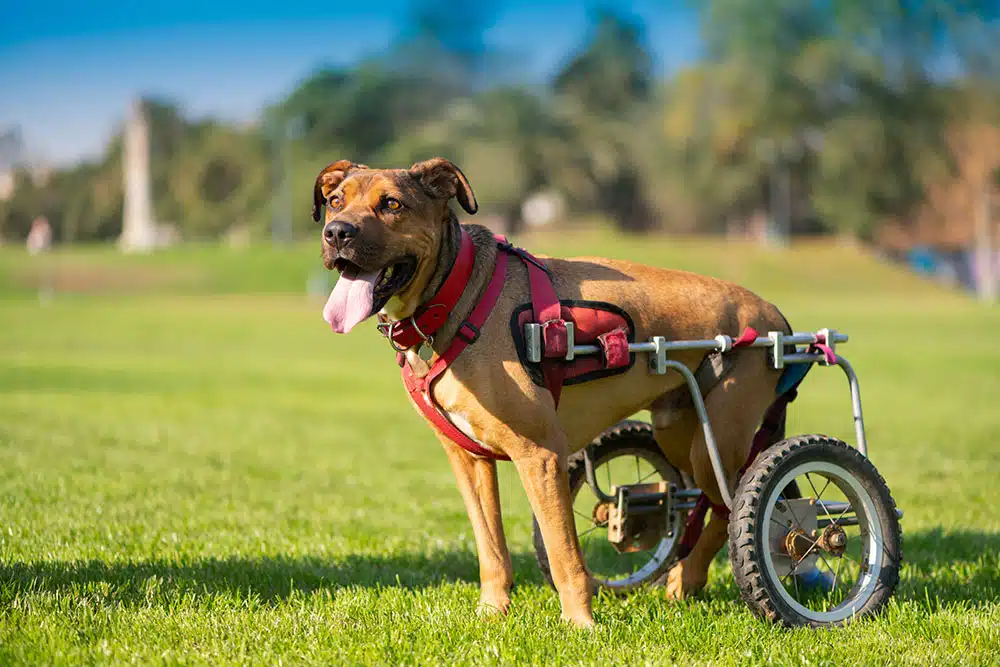
Mobility carts for dogs take the weight off rear legs that can no longer carry it, and most dogs use one for walks, yard time, and sniffing expeditions rather than sitting in it all day. For a dog whose back legs have stopped holding, that’s the difference between watching the family leave and going along.
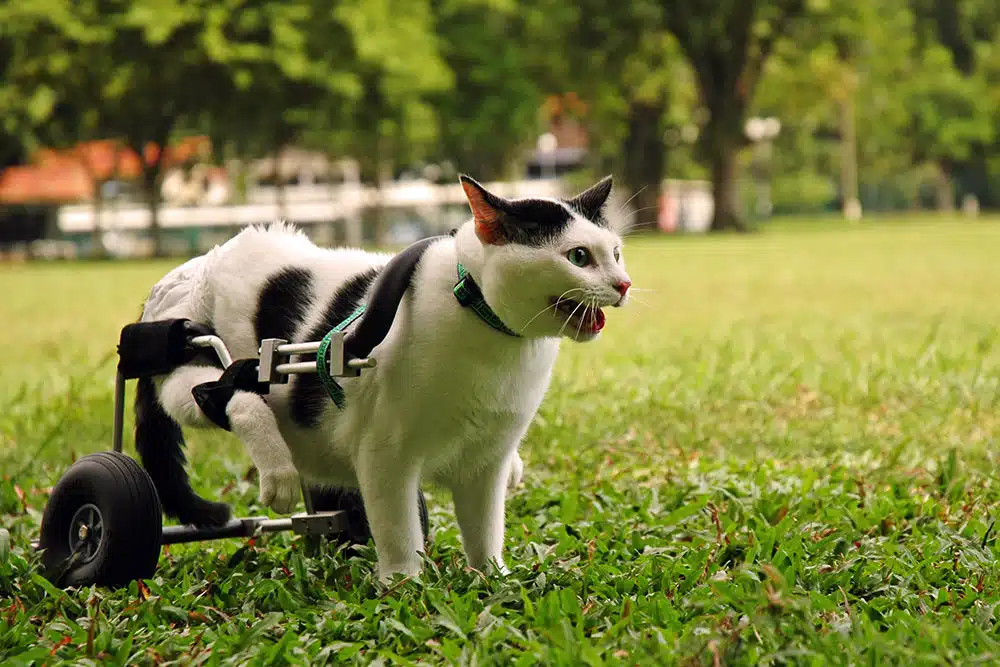
A cart isn’t a last resort and it isn’t a chair. Fit has to be precise, since a frame that rubs raises pressure sores in a hurry, and most dogs settle in across a week or two of short, upbeat sessions rather than one ambitious outing. A dog who can’t rise on his own needs a little extra watching too: check that he’s emptying his bladder, keep bedding clean and dry, and tell us if you see urine scalding on the skin or a reddened pressure point. Plenty of senior dogs live years this way, still greeting the mail carrier at speed. Carts exist for cats as well, and a few tolerate them nicely, though most sore cats do better with a thoughtful ground-level setup.
What Condition Is Driving the Weakness?
Naming the condition tells you how support will change over time. Arthritis asks for steady help that grows slowly. A disc injury asks for intensive help that often fades as the spinal cord heals. A nerve disease asks you to stay one step ahead of it. The device follows the diagnosis, never the reverse. Here are the most common reasons we see pets need mobility support:
- Osteoarthritis: the most common driver by a wide margin, where a harness smooths the transitions while pain control and weight management work on the joint itself.
- Sudden rear-end weakness: intervertebral disc disease can put a dog down in the space of a morning, and recovery usually runs through weeks of harness support while the spinal cord heals. Some pets will be permanently paralyzed and need a cart long-term.
- Degenerative myelopathy: this spinal cord disease moves slowly, starting with worn nails and a wobble in the rear and progressing steadily, so support climbs from traction aids to a harness to a cart as the months go on.
Telling these apart takes a careful orthopedic and neurologic exam, and our veterinarians pair that with imaging before anyone recommends a product. When the answer sits deeper than radiographs can reach, we refer to a specialty hospital for MRI and coordinate the visit for you.
What Else Belongs in the Plan Besides the Device?
A harness or a cart handles the mechanics of moving. Neither one treats the pain, the extra pounds, or the muscle loss underneath, and those three shape comfort more than anything you can buy.
| Piece of the plan | What it does |
| Pain control | Anti-inflammatories, a monthly injection that blocks an arthritis pain signal (separate versions exist for dogs and for cats), and other medications matched to the underlying cause |
| Weight management | Lightens the load on every joint at once, often outperforming any single product |
| Joint supplements and omega fatty acids | Support cartilage and calm inflammation in the cases that call for them |
Rest alone lets muscle melt away, while veterinary physical rehabilitation uses targeted exercises to rebuild the strength and balance that keep a senior pet upright between appointments. We’ll connect you with a certified rehabilitation practitioner and keep a hand in the plan. Because needs shift over months rather than years, regular senior rechecks are how we catch the next stage before it catches you.
Common Questions About Senior Pet Mobility Aids
Will using a harness make my dog’s back end weaker?
Used the right way, no. A harness is for the hard moments, like stairs, slick floors, and standing up, while your dog keeps doing the walking he can still manage. That preserved movement is exactly what holds onto muscle. Weakness comes from the disease itself and from lying down more, not from a lift at the top of the steps. If you find yourself carrying the whole back end on every walk, that’s a sign to recheck the plan, not to abandon the harness.
My cat won’t tolerate anything strapped on. What are my options?
Plenty, and most of them don’t touch her. Sore cats respond well to pain medication made for feline patients, and a reworked environment does much of the rest: a litter box with a low entry, a step or two up to the couch, food and water on the floor she uses most, and warm bedding that doesn’t require a jump. Feline harnesses and carts do exist, so keep them on the table, but comfort at home usually comes first for cats.
What should I do if my dog goes down at night or on a weekend?
Keep him flat, quiet, and off slippery footing, support the rear with a towel sling if you must move him, and head to the nearest emergency hospital instead of waiting for morning. The after-hours emergency hospitals we recommend are listed for the times we’re closed. A dog who can’t bear weight needs eyes on him within hours, since sudden spinal problems often have a treatment window. Call us the next business day so we can pick up the plan from there.
What to Do Next If Your Pet Is Slipping
Watching a companion of twelve years hesitate at the bottom of the stairs is hard, and you don’t have to sort out the next move alone. Start with the diagnosis, match the aid to the stage your dog or cat is in right now, and keep pain, weight, and strength on the plan beside it. If your senior pet has started slipping, stalling before the stairs, or waiting for a boost, reach out and we’ll take a look together here at Oliver Animal Hospital in Austin.




Leave A Comment